Friday, November 10, 2023

Baptism

On this day, in 1968, I was baptized.

Thank you, to my parents, for being faithful in bringing me to the waters of baptism, and for teaching me in the Faith.

"He saved us, not on the basis of deeds which we did in righteousness, but in accordance with His mercy, by the washing of regeneration and renewing by the Holy Spirit." Titus 3:5

Belated Remembrance


Friday, January 29, 2021

The Nations Were Always The Plan

I was listening to someone recently talk about the nations being God's plan from the beginning. His command to His people after the flood was to be fruitful and multiply, and to fill the earth. Filling the earth would result in geographic separation which would result in new language dialects, cultural separation, and genetic drift, since separated populations would be breeding with a small subset of the total gene pool. Perhaps there would never have been radically different languages, but the nations would have been born all the same.

So, the incident at the tower of Babel was not introducing the concept of nations as a mitigation of the evil of a unified people. It was introducing different languages to force the development of nations, which was His desire all along.

I'll amend this if I remember to whom I was listening when this became clear to me.

Saturday, February 16, 2019

Blacksmithing


I love Torbjörn's presentation style and the level of organization and "neatness" in his shop and work. Here is a demonstration of the making of a bearded axe, which I hope to be able to achieve...some day.

You can find him on YouTube here: Torbjörn Åhman

Friday, December 21, 2018

Child Training 101, Lesson 1: It is Not Optional

"Whoever spares the rod hates his son, but he who loves him is diligent to discipline him." Proverbs 13: 24


"Train up a child in the way he should go; even when he is old he will not depart from it." Proverbs 22: 6

"Foolishness is bound up in the heart of a child; The rod of discipline will remove it far from him." 
Proverbs 22:15


"Do not withhold discipline from a child; if you strike him with a rod, he will not die. If you strike him with the rod, you will save his soul from Sheol." Proverbs 23: 13, 14

"For the moment all discipline seems painful rather than pleasant, but later it yields the peaceful fruit of righteousness to those who have been trained by it." 
Hebrews 12: 11


It is not only okay to discipline your children, it is necessary to discipline them, if you love them. 

And, by "discipline", the Bible means spanking -- corporal punishment. There is absolutely no ambiguity in these verses. They say, "strike him with a rod." If you fail or refuse to spank your children, you hate them. If you love them, you will be diligent to spank and comprehensively train and discipline them.

This is the first lesson of raising children to glorify God.

I know many parents who could never come to terms not only with this, but also with even telling their children "no." They could not take God at his word and believe and trust Him enough to obey Him in this very basic command. They thought that they were pursuing a better, more enlightened, more loving way, but in reality, they were treating their children as if they hated them.

They did not consistently discipline their young children, and when they got older, they were incapable of saying "no" or of refusing to indulge their whims. 

The fruit of these dysfunctional parental relationships with their children is older children who are self-willed, unmoored, disobedient, and drifting from God.

Discipline, including spanking, is an indispensable aspect of raising children to love and glorify God. It is the first requirement, before any other training can happen. 

Saying no when your children want to do things that are foolish or dishonoring to God, and not giving in to their persistent pleas, although it can be unpleasant at times, "yields the peaceful fruit of righteousness." It might not seem like it, right after you have spanked your son or daughter, but it will. When you are in the middle of those years, you have to trust that God's Word is true in this as in everything else. I can assure you that His Word is true and you will see the fruit.

You will not find a better way, because there is no better way. 

The one who made you and your children has also told you what you need to do to train and discipline them. If you think you will discover a more spiritual, loving, and effective way to raise your children, you are wrong. You are arrogant and the Bible says you hate your children.

Love your children! Teach them at home. Read the Bible to them. Teach them to obey you and God. Show them what love and forgiveness mean. And spank them when they are disobedient.

Tuesday, August 21, 2018

The Transformed Wife


Here is a wonderful blog by a woman who is not listening to the voices of the World and the spirit of Feminism that is a cancer on our society and even in our churches. She writes this about her blog:

"My ministry is based upon Titus 2:3-5 in which God commands that older women teach younger women to be sober, love and obey their husbands, love their children, be chaste, discreet, good, and keepers at home. If you would love to learn and grow in these areas and allow God's Word and His ways to transform your marriage and your life, please join me as I teach you what I have learned from His Word, my own experience and mentoring many women, and most importantly, allowing the Holy Spirit to convict and transform you into the image of Christ."

Read more here: The Transformed Wife

I recommend it highly.

Friday, April 13, 2018

Stop Apologizing


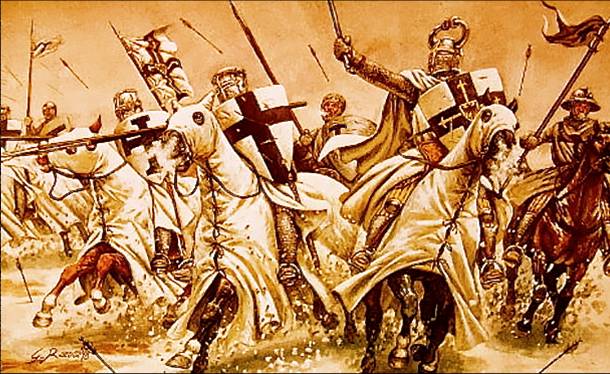
Image result for the crusades

I'm ashamed at my level of ignorance of History. When we don't know history in general, and our own history in particular, not only are we, as a society, doomed, as it is said, to repeat the mistakes of our past, but we fall easy prey to guilt-peddlers.

Guilt-peddling is all the rage these days. Secular as well as Christian Progressives love to beat Western Civilization over the head with its supposed atrocities for which it apparently can never be forgiven. 

The Crusades are a perennial favorite for this purpose. Christianity is, of course, a religion of hypocrisy because of the Crusades. Self-righteous unbelievers and self-flagellating believers have only to utter the word "crusades" and Western Christianity is supposed to fall silent and beg forgiveness, yet again.

I have always assumed that there is a lot more to the story than we were taught in the government schools, but have been too lazy to look very far into it. Stefan Molyneux has an excellent lesson where he gives a very high-altitude look at some of the historical background that sparked the Crusades.

You can find it here, and I highly recommend it. (Original Source. Stefan has been cancelled by YouTube, but the link below is a repost on another channel.)
Alternate Source

Listen and see if it doesn't have a profound effect on how you think about the past that you take for granted.

I'll paraphrase, amplify, and expand one of the crucial points he makes near the end of his talk. Of all of the civilizations to ever exist on this planet, there is precisely one that engages in critical moral self-reflection and changes on the basis of it: Western Civilization, a/k/a Christendom. 

This isn't an intrinsic virtue of the men and women of the West, it is a direct result of the work of the Holy Spirit. Don't be ashamed of the legacy of Christendom, which the Progressives and the haters of Christ are doing their best to wipe out and erase from the history books. Learn the history, teach it to your children, and be proud of it. Be proud not for the works (either righteous or sinful) of Man, but because it is the work of God.

Christendom was not and is not sinless, but only Christendom confesses, repents, and turns to God. Pagans don't. Buddhists don't. Atheists don't. Zoroastrians don't. Muslims sure don't. 

Stop apologizing.

Saturday, March 10, 2018

Book Review: Instruments in the Redeemer's Hands


Instruments in the Redeemer’s Hands, by Paul David Tripp, presents a remarkable and refreshingly biblical approach to achieving change in people’s lives. It is a book that addresses the deep needs of those who are acutely suffering, but also every one of us as it teaches us to minister in a biblical way, one unto another.

Tripp lays a good foundation by explaining who we are in God’s creation, what the effects of sin are on every one of us, and why we need Jesus. The book gets its title as he explains how we are each used as an instrument of Christ to work his redemption in the lives of others. In turn, others are used as instruments of change in our lives. He powerfully ties this into our role as God’s ambassadors who are incarnating Christ at every moment.

Another of the categorical differences between this book and other approaches to life-change is the focus on the significance of the heart as the source of our sin and broken lives. The heart becomes the target for change as it is compared with scripture and God’s will for us to glorify him and enjoy him.

After preparing the foundation, Tripp spends the majority of the book describing a model for building relationships and actually being the instrument God uses to work change in people’s lives. The model is called “Love, Know, Speak, Do.” Love is the over-arching and motivating part of the equation. It encompasses God’s love for us as well as our love for one another. Know is the process of developing deep and caring relationships, through which change and mutual admonition can happen. Speak deals with truth and the need for godly and loving confrontation, not just in the big things, but as a natural and organic part of our corporate lives. Finally, Do is concerned with action, responsibility, and accountability for the long haul.

His instruction is thorough, comprehensive, and detailed. It is also very practical, with specific examples and suggestions about how to implement each of the four aspects of the model. Without reservation, I recommend this book to anyone who is in formal counseling or discipling relationships, but also to anyone who wants greater insight into his own heart and who wants to more fully reflect Christ to others.

Thursday, November 23, 2017

Happy Thanksgiving

For God so loved the world, that He gave His only begotten Son, that whoever believes in Him shall not perish, but have eternal life.

John 3:16


For by grace you have been saved through faith; and that not of yourselves, it is the gift of God; 9 not as a result of works, so that no one may boast. 10 For we are His workmanship, created in Christ Jesus for good works, which God prepared beforehand so that we would walk in them.

Ephesians 2: 8 - 10

Thursday, November 9, 2017

Race, part 1

John Piper has a really hard time with the concept of race.
I’m a stickler for clear definitions. I like to know what I am talking about. ... Believe it or not, the existence of the reality of race itself is disputed. I mean seriously by very wise people whom I admire. I deal with this in appendix 1. And, of course, the term racism is ambiguous as well. (Bloodlines, pg 17)
It is a healthy sign to wish that the term race did not exist. It has not served well to enhance human relations. In general, the term race has been used to signify “a biological concept referring to the taxonomic (classificatory) unit immediately below the species.” We may not be able to communicate in our day without the term, but we can at least try to show why it is a fuzzy term that is minimally helpful and has often been hijacked by ideology for racist purposes. (Bloodlines, Appendix One, pg 234)
I get a little nervous when I'm reading something where the author takes pains to define words in ways that are not standard. My shields go up and I wonder why he would need to do that.

Is "race" really a difficult word to define? Here is the dictionary definition from dictionary.com:
1. a group of persons related by common descent or heredity.
2. a population so related.
3. Anthropology. [omitted] (no longer in technical use)
4. a group of tribes or peoples forming an ethnic lineage:
5. any people united by common history, language, cultural traits, etc.:
6. the human race or family; humankind
That is quite straight-forward and agrees with most people's common sense understanding. Piper says he's a stickler for clear definitions, but he has taken something clear and intentionally made it, in his words, fuzzy. I also wonder if he is engaging in psychological projection when he states that the term has "often been hijacked by ideology."

It should also be absolutely no surprise to Christians that various races of humankind exist. God Himself created the condition that resulted in the proliferation of distinct people groups that became identifiable in terms of their geography, cultures, and physical characteristics.
The Lord came down to see the city and the tower which the sons of men had built. 6 The Lord said, “Behold, they are one people, and they all have the same language. And this is what they began to do, and now nothing which they purpose to do will be impossible for them. 7 Come, let Us go down and there confuse their language, so that they will not understand one another’s speech.” 8 So the Lord scattered them abroad from there over the face of the whole earth; and they stopped building the city. 9 Therefore its name was called Babel, because there the Lord confused the language of the whole earth; and from there the Lord scattered them abroad over the face of the whole earth. (Genesis 11: 5-9)
God's intentional sundering of humanity at the tower of Babel led directly to the rise of the nations and the division of mankind into a diversity of races. And, He did it for our good, to limit Man's potential for evil, and to force Man into obedience to Him.

Yet, Piper says that it is a "healthy sign to wish that the term race did not exist." Why would we "wish" for that? Is it so we could more easily pretend that race itself doesn't exist? So we can pretend that one of God's blessings doesn't exist? So we can remake the world God created into one of our own imagination?

The secular Progressive world is waging war against God's created order. They hate that God created Man, male and female, so they seek to destroy the distinction and create a fluid continuity of "genders." They hate that God blessed husbands and wives with distinct responsibilities and gifts, so they work tirelessly to destroy and pervert marriage.

They also hate that God created The Nations, so they work toward a globalist future and vilify the term "nationalism" and anyone who stands for national sovereignty.

And, maybe most of all, they hate that God created the races. While they dishonestly call for greater Diversity, they in reality promote the obliteration of the glorious variety of Man.

Whatever God has created, they will seek to destroy and replace with its opposite.

I haven't made it far into Piper's book, but at the outset he appears to be lined up on the opposite side of the battlefield.

Thursday, November 2, 2017

No Small Miracles

Years ago, I was talking with an atheist acquaintance about the Bible. Among his reasons for discounting the Bible's reliability was the frequent recounting of miracles. He particularly objected to the ones, like God making the sun stand still (Joshua 10: 1-15), that were simply impossible to his mind.

The sun wouldn't actually be standing still, he said, it would be the earth that would have to stop rotating on its axis! Did I know, he asked, what would happen if the earth stopped rotating? Then he told me about the physical ramifications of a non-rotating earth. So, he continued, not only would my so-called god have to stop the earth's rotation, but he'd have to deal with the meteorological consequences and all of the other difficulties that would arise.

So, I got the impression that he thought that the miracle in the valley of Aijalon was absurd because it would be Really Hard for a theoretical god to pull it off.

This guy was seriously smart. Way smarter than me, but I still think that he was totally missing the point about Who God is.

This morning, on the drive in to work, I was listening to the Dangerous History Podcast about the "Grunt's Eye Perspective" of the Civil War, and it reminded me of one of my two favorite miracles in the Old Testament.
Your clothing did not wear out on you, nor did your foot swell these forty years.
Deuteronomy 8:4
Listen to the description of what the Civil War soldiers endured regarding clothing and footwear and you will get a new appreciation for what this meant. The American Civil War lasted roughly four years. The People of God wandered and fought in the desert for forty years and their clothing (including sandals) did not wear out.

Every day that their wandering continued they were presented with an ongoing miracle of preservation. I wonder if they stopped thinking about it after a while.

I know that I stop thinking about God's ongoing preservation and blessings in my life.

Some other time I'll mention my number one favorite Old Testament miracle.


Wednesday, May 10, 2017

Who is influencing you?


Image result for person reading painting


In the latest Forward Tilt, Isaac Morehouse thinks about this rule-of-thumb: 
"We are the sum of the five people with whom we spend the most time." 
He proposes a great exercise that might lead to the conclusion that we should make some changes.

But, consider also that the people with whom you spend the most time may not be living, or you may not be spending physical time with them. It would be worthwhile to repeat Isaac's exercise with the five people you spend the most time reading.

We become the things in which we immerse ourselves.

UPDATE:
This past Sunday, Kevin DeYoung preached a sermon on Exodus 34:29-35, in which he gets to the heart of this matter. Can people tell that we have been in the presence of God and immersed in His Word?

https://www.universityreformedchurch.org/sermons/till-we-have-faces/

Sunday, May 7, 2017

Why we are not libertarians...

Walter Block has stated that,
"The non-aggression axiom is the lynchpin of the philosophy of libertarianism. It states, simply, that it shall be legal for anyone to do anything he wants, provided only that he not initiate (or threaten) violence against the person or legitimately owned property of another."
The non-aggression axiom, also known as the non-aggression principle ("NAP"), depends upon another libertarian axiom, the Sovereign Individual ("SI"). This is the assertion of the self-ownership of the individual, who has complete and total control over his own body and life, owing nothing to anyone else that he has not voluntarily contracted to provide. No other individual, group, corporation, or government may rightly constrain, coerce, or deprive the Sovereign Individual.

The NAP is the necessary governing principle between Sovereign Individuals which keeps one individual's total sovereignty from conflicting with another's. It is a limit on the Sovereign Individual, but a vital one if the system is to hope to work.

There is a lot to like in this system and it even sounds somewhat moral, as if it were a more rigorous version of "do unto others," or "live and let live."

However, the problem with the NAP and the SI is that they are specific, direct, and intentional repudiations of God's Word.

We are, in reality, not sovereign, nor is it legal for us to do anything we want (even with the proviso of the NAP).

God has proclaimed a Law and regardless of your particular understanding of the continuity of the covenant, no Christian denies that we are still subject to at least some of God's Law. Specifically, there are a great many things which are unlawful and which do not initiate or threaten violence against others. Drunkenness (drug use), extra-marital sex, blaspheming the name of the Lord, usury, dishonoring parents, idolatry, and covetousness are all examples. 1 Corinthians 6:8-10 gives a list of people who will not inherit the Kingdom. Well over half of the types of people on the list are engaged in "victimless crimes."

The NAP is false.

It is even more absurd to assert that the individual is sovereign. In what possible way is a man, created by God, subject to His Law, wholly dependent up His grace and mercy and upon the atoning work of Jesus, and commanded to worship and serve him, sovereign?

There are multiple times in Scripture where God's people are indicted for acting as sovereign individuals. Most notably, during the time of the judges, everyone was said to be doing what was "right in his own eyes." Despite the eisegesis of some libertarian commentators, this was not a description of a libertarian paradise. A plain reading of the book of Judges is enough to dispel that notion. The books of Deuteronomy, Proverbs, and Job also use the phrase in a negative way.

But, libertarians are not necessarily believers in God and His Word, and this is the point. The NAP and the SI are attempts to create a workable system of human liberty apart from God. Libertarianism is fundamentally at odds with God's created order and seeks to achieve a state of human freedom that is hostile to the true Christian liberty we have when we are in submission to Christ.

I think many Christians find libertarianism attractive because it does have significant, incidental points of commonality with a Christian society. On can cherry-pick specific libertarian principles and have a sense that there is a form of Christian libertarianism. It isn't necessary to do this. These commonalities (private property being a key one) already exist as concepts in God's created economy. We don't need libertarianism to teach it to us.


Libertarianism also provides a great platform for attacking the leviathan State and its tyranny over every aspect of our lives.


But neither is it necessary for Christians to turn to libertarianism for this. God's Word places individuals, families, nations, and states under the Sovereignty of God and in submission to his Will and Law. Opposing the godless state from the perspective of Scripture is a far more effective strategy than resorting to the man-made, utopian philosophy of libertarianism.


There is nothing true in libertarianism that is not already found in God's Word.


If there is any hope of a better society on earth than the one we have it will be as more individuals, families, nations, and states are transformed by the Spirit of God and come under His Sovereignty and the authority of His Word, not by adopting the fantasy of libertarianism.

Monday, April 10, 2017

An Ignominious Anniversary

Last week, Thursday, April 6, was the 100th anniversary of the entry of the United States into World War I, which put a brutal end to a long period of relative American international non-interventionism. It is likely that the outcome of the war was influenced for the worse by our country's entry into it. In any case, the only winner in that war was The State.

For a dramatic narrative of the war listen to Dan Carlin's Blueprint For Armageddon. It is, as of this publication, still in his current episodes and, consequently, free. Dan is an odd sort of Statist, but his historical accounts are first-rate and worth every minute of your time.

For a discussion that you probably did not hear in the public schools, try Tom Woods's April 5 interview with Hunt Tooley, "The U.S. Enters World War I: Wilson’s Folly Revisited, a Century Later."

Sunday, February 5, 2017

Sojourners?

The sermon at the church where I attended today was an examination of Exodus 22:16 through Exodus 23:19, with particular attention paid to the concept of "social justice", which happens to be the heading for the passage beginning at 22:16, as applied by the publishers of the English Standard Version.

The Pastor prefaced his remarks with a good warning regarding the baggage associated with the term "social justice" and the danger of using it as an uninspired heading for the verses it attempted to summarize. We should let the Bible tell us what justice is, he said. I agree.

He then read the entire passage in a slow, deliberate, and reverential manner. His sermon categorized the verses as being related to justice in either a vertical way (with respect to God) or horizontally (with respect to one-another), with particular attention paid to the weak or vulnerable. Most of the remaining time was given to the exegesis of each of the verses in the passage, without omitting any of them. Furthermore, the text was treated as authoritative.

This is something that is rare in my experience: an extended reading of the Old Testament followed by an exegetical sermon which promotes the authority and applicability of the text, without transforming it to a modern personalized and spiritualized message. It was very refreshing.

However, the pastor did make an excursion of sorts in his discussion of two of the passages, Exodus 22:21 and 23:9, as related to the current event of the contested travel ban issued by President Trump in his first week in office.
“You shall not wrong a sojourner or oppress him, for you were sojourners in the land of Egypt." (22:21)
"You shall not oppress a sojourner. You know the heart of a sojourner, for you were sojourners in the land of Egypt." (23:9)
He recommended a book, The Immigration Crisis, by James K. Hoffmeier, and referred to it regarding the various categories and distinctions of the inhabitants of the land of Israel: citizens, foreigners, and sojourners. Sojourners, the subject of the two verses, were legal and permanent residents who had adopted the laws, customs, and religious beliefs and practices of Israel.

Strangely, even after citing the book, no real mention of the book's contents or conclusions were mentioned. In fact, the two passages above were treated in a way that left me with the impression that they were directly applicable to the current situation of immigration and refugees that dominate international attention.

The Pastor did say that it is important to note that Scripture does not say how many strangers or sojourners a nation is to allow and that Christians should make allowances for differences of opinion on the subject, and he did highlight the distinction between foreigners (visitors) and sojourners, but otherwise the two verses regarding sojourners were not closely examined in their original context, nor was there much analysis of their applicability in the current crisis.

Hoffmeier, however is more clear on the matter. In an article summarizing some of his book's observations he says the following.
"From the foregoing texts we can conclude that in the ancient biblical world, countries had borders that were protected and respected, and that foreigners who wanted to reside in another country had to obtain some sort of permission in order to be considered an alien with certain rights and privileges. The delineation between the “alien” or “stranger” (ger) and the foreigner (nekhar or zar) in biblical law is stark indeed. The ger in Israelite society, for instance, could receive social benefits such as the right to glean in the fields (Leviticus 19:9-10; Deuteronomy 24:19-22) and they could receive resources from the tithes (Deuteronomy 26:12-13). In legal matters, “there shall be one statute for you and for the stranger who sojourns with you, a statute forever throughout your generations. You and the sojourner shall be alike before the LORD. One law and one rule shall be for you and for the stranger who sojourns with you” (Numbers 15:15-16). In the area of employment, the ger and citizen were to be paid alike (Deuteronomy 24:14-15). In all these cases, no such provision is extended to the nekhar or zar. In a sense, the ger were not just aliens to whom social and legal protections were offered, but were also considered converts, and thus could participate in the religious life of the community, e.g. celebrate Passover (Exodus 12:13) and observe Yom Kippur, the day of atonement (Leviticus 16:29-30). They were, moreover, expected to keep dietary and holiness laws (Leviticus 17:8-9 & 10-12). It is well known that within Israelite society, money was not to be lent with interest, but one could loan at interest to a foreigner (nekhar). These passages from the Law make plain that aliens or strangers received all the benefits and protection of a citizen, whereas the foreigner (nekhar) did not. It is wrong, therefore, to confuse these two categories of foreigners and then to use passages regarding the ger as if they were relevant to illegal immigrants of today." (Emphases mine.)
There are other observations that, I think, should be made regarding the text concerning sojourners in Exodus, in light of the rest of the Law.

  • Israel was a people apart from all other nations, devoted to the one true God.
  • Israel had very definite boundaries.
  • There was to be no mixing with the nations, no intermarriage with pagans, and no cultural "exchanges".
  • As the laws prohibiting all forms of idolatry make clear, no sojourners would be permitted to worship any god but the one true God. (E.g. 22:20) There was to be no religious toleration. Period.
  • Sojourners were few in number.
  • Sojourners were not to be permitted to create cultural enclaves.
  • Sojourners were not permitted to practice their imported national laws.
  • Sojourners were not permitted to subvert the culture and worship of Israel.
  • There was no category in Israel that is equivalent to an "illegal alien."
  • Unless fully incorporated into a specific tribe and family via marriage, a sojourner was without inheritance in the land of Israel.
  • Certainly, mass-immigration, or, statistically significant numbers of sojourners, would not have been permitted.
  • Certainly, mass-illegal-immigration would have been seen as equivalent to invasion.
  • The law regarding sojourners was to remind Israel that the sojourner had accepted the Law, people, and God of Israel as their own. They were not foreigners any longer. Simply treating them with compassion was not the only point of the verses.
  • Undoubtedly, visiting foreigners were also not to be mistreated and oppressed, but such common charity was covered elsewhere in the law.

Christians, too, should deal with all people with charity and compassion, whether they are foreigners, citizens, or sojourners as long as they are respecters of the laws of God and man. There are limits to charity and compassion.


The United States is not Israel and the massive numbers of immigrants, legal or otherwise, do not resemble the sojourners within ancient Israel in any meaningful way. Therefore, I conclude that Exodus 22:21 and 23:9 are not applicable in a direct way to our current immigration crisis.

However, I do believe that the concept of sojourner is instructive and that a nation that wants to preserve itself as a nation, especially if that nation is a Christian one (II Corinthians 6:14 - 7:1), should model its immigration policy after that of ancient Israel.

Immigrants should be relatively few. Immigrants should not be permitted to import their foreign gods or cultures. Immigrants should not be permitted to form enclaves that are resistant to the native culture or that undermine the native culture. Immigrants should fully embrace the law, culture, and worship of their new nation.

There is a lot of secular Progressivism and neo-Babelism today that masquerades as compassionate Christianity. Today's sermon was certainly not that, however it left open the door for very easy misinterpretation.

If the Church wants to be shaping the nation's future, rather than continuing to be swept along by events and continually reacting defensively and fearfully to them, it will have to deal with the issue of mass-immigration in a more thorough and comprehensively Biblical way.


UPDATE: I have since read The Immigrant Crisis. It is a easy read, being essentially an extended version of the article to which I link above. There is nothing substantially new or different in the book, compared with the article, but it is much more comprehensive and is worth reading, nonetheless. Aside from a comment or two near the end, when the author strays from exegesis into commentary, I can recommend it.

Sunday, December 25, 2016

Merry Christmas!

8 In the same region there were some shepherds staying out in the fields and keeping watch over their flock by night. 9 And an angel of the Lord suddenly stood before them, and the glory of the Lord shone around them; and they were terribly frightened. 10 But the angel said to them, “Do not be afraid; for behold, I bring you good news of great joy which will be for all the people; 11 for today in the city of David there has been born for you a Savior, who is Christ the Lord. 12 This will be a sign for you: you will find a baby wrapped in cloths and lying in a manger.”13 And suddenly there appeared with the angel a multitude of the heavenly host praising God and saying, 
14 “Glory to God in the highest,
And on earth peace among men with whom He is pleased.”

I pray that you are enjoying this time of celebration of and reflection on the Incarnation of the Word of God as our Lord and Savior.

-Team Treebeard


Also, if you haven't already joined the Alt-tech revolution, abandoned the SJW-infested and thought-policed Wikipedia (letting the dead bury their dead), and switched to Infogalactic, maybe this will give you some motivation.


Friday, December 23, 2016

The Nations

The nations were created by God as a result of the incident at the tower of Babel. Prior to that there were no nations, just Man.

Previously, Man had become so thoroughly wicked that God destroyed them all, except one man, his wife, their sons, and their son's wives. Then, after being somewhat fruitful and multiplying, Man again became exceedingly wicked. This time, their disobedience included defying the following specific command from God.

And God blessed Noah and his sons and said to them, “Be fruitful and multiply, and fill the earth." (Genesis 9:1) 
“As for you, be fruitful and multiply; Populate the earth abundantly and multiply in it.” (Genesis 9:7)
God specifically told Noah to fill the earth, which would require that they spread out. But, a few generations later this is what Man was thinking.
Now the whole earth used the same language and the same words. 2 It came about as they journeyed east, that they found a plain in the land of Shinar and settled there. 3 They said to one another, “Come, let us make bricks and burn them thoroughly.” And they used brick for stone, and they used tar for mortar. 4 They said, “Come, let us build for ourselves a city, and a tower whose top will reach into heaven, and let us make for ourselves a name, otherwise we will be scattered abroad over the face of the whole earth.” (Genesis 11:1-4)
God noticed Man's rebellion and took the matter out of their hands by breaking them up into groups based on new languages that He created for them.
The Lord came down to see the city and the tower which the sons of men had built. 6 The Lord said, “Behold, they are one people, and they all have the same language. And this is what they began to do, and now nothing which they purpose to do will be impossible for them. 7 Come, let Us go down and there confuse their language, so that they will not understand one another’s speech.” 8 So the Lord scattered them abroad from there over the face of the whole earth; and they stopped building the city. 9 Therefore its name was called Babel, because there the Lord confused the language of the whole earth; and from there the Lord scattered them abroad over the face of the whole earth. (Genesis 11: 5-9)
No longer being unified under one language (and, I would surmise from the context, one culture), the new language groups went their separate ways. From this break-up the nations, their cultures, and races (genetically distinct groups resulting from population isolation and inbreeding) arose.

This was God's doing. It was a judgment against Man, but He did it for Man's good. It prevented their continued disobedience to the command to fill the earth, and it restrained the degree of evil to which they could attain. (v.6)

Ever since, God has directed the nations according to His purposes, a notable example being Cyrus the Persian. God used Cyrus and the previously non-first-rate power of the Medes and Persians to conquer the known world, supplanting and executing judgment on the Assyrians. Isaiah 44 and 45 make it clear that it was the Lord's doing. Not only did He raise Cyrus up, but he softened his adversaries so that his victory was easier.


Throughout Scripture, God calls the nations by name and directs them as he wills. He created a new nation through one man, Abram, to be his People.

Furthermore, there is no indication whatsoever in Scripture that the nations will ever cease to exist or that the dissolution of the nations is something that God intends or for which God's People should strive.

To the contrary, God gave as his Great Commission to His Church the task of redeeming the nations and reconciling them to Him.
And Jesus came up and spoke to them, saying,“All authority has been given to Me in heaven and on earth. 19 Go therefore and make disciples of all the nations, baptizing them in the name of the Father and the Son and the Holy Spirit, 20 teaching them to observe all that I commanded you; and lo, I am with you always, even to the end of the age.” (Matthew 28: 18-20)
Now all these things are from God, who reconciled us to Himself through Christ and gave us the ministry of reconciliation, 19 namely, that God was in Christ reconciling the world to Himself, not counting their trespasses against them, and He has committed to us the word of reconciliation. 20 Therefore, we are ambassadors for Christ, as though God were making an appeal through us; we beg you on behalf of Christ, be reconciled to God. (II Corinthians 5: 18-20)
The reconciliation that God's People are to proclaim is that between the World (the nations) and God. It is the nations who are to be the object of the church's ministry and teaching. Nowhere has He directed the church to work to eliminate the nations, to pretend that they are somehow illegitimate or unfortunate, or to consider them to be anything less than His creation for our good. 

The nations also will still be present at the end of all things. "the peoples and tribes and tongues and nations" are present throughout the events described in the book of the Revelation of Jesus Christ. So, any effort to eliminate or unify the nations is not only contrary to God's plan, but is obviously futile. And, if dividing the nations restrained evil, seeking to unify them is to seek to increase evil.
22 I saw no temple in it, for the Lord God the Almighty and the Lamb are its temple. 23 And the city has no need of the sun or of the moon to shine on it, for the glory of God has illumined it, and its lamp is the Lamb. 24 The nations will walk by its light, and the kings of the earth will bring their glory into it. 25 In the daytime (for there will be no night there) its gates will never be closed; 26 and they will bring the glory and the honor of the nations into it; 27 and nothing unclean, and no one who practices abomination and lying, shall ever come into it, but only those whose names are written in the Lamb’s book of life. 
1 Then he showed me a river of the water of life, clear as crystal, coming from the throne of God and of the Lamb, 2 in the middle of its street. On either side of the river was the tree of life, bearing twelve kinds of fruit, yielding its fruit every month; and the leaves of the tree were for the healing of the nations. 3 There will no longer be any curse; and the throne of God and of the Lamb will be in it, and His bond-servants will serve Him; 4 they will see His face, and His name will be on their foreheads. 5 And there will no longer be any night; and they will not have need of the light of a lamp nor the light of the sun, because the Lord God will illumine them; and they will reign forever and ever. (Revelation 21:22 - 22:5)
This is a vision of the nations in submission to and reconciled with the LORD.

The point of all this is that Treebeard and I were wondering why there are such negative assumptions flourishing regarding the current trends away from multiculturalism and globalism and toward nationalism.

Secular Progressivism has been trying to recreate the pre-Babel world for decades, and it is understandable why the enemies of God would be opposed to His ordering of the world, but why do so many in the evangelical church also seem to share this agenda?

More on that to come...

Thursday, November 24, 2016

Happy Thanksgiving!

Give thanks to the Lord, for He is good;
His love endures forever. 

1 Chronicles 16:34 

Wednesday, November 16, 2016

Bread and Wine

14 When the hour had come, He reclined at the table, and the apostles with Him. 15 And He said to them, “I have earnestly desired to eat this Passover with you before I suffer; 16 for I say to you, I shall never again eat it until it is fulfilled in the kingdom of God.” 17 And when He had taken a cup and given thanks, He said, “Take this and share it among yourselves; 18 for I say to you, I will not drink of the fruit of the vine from now on until the kingdom of God comes.” 19 And when He had taken some bread and given thanks, He broke it and gave it to them, saying, “This is My body which is given for you; do this in remembrance of Me.” 20 And in the same way He took the cup after they had eaten, saying, “This cup which is poured out for you is the new covenant in My blood. 21 But behold, the hand of the one betraying Me is with [c]Mine on the table. 22 For indeed, the Son of Man is going as it has been determined; but woe to that man by whom He is betrayed!” 23 And they began to discuss among themselves which one of them it might be who was going to do this thing.

Luke 22:14-23


Without a doubt, Jews celebrating the Passover in the first century were drinking wine and eating unleavened bread when Jesus instituted the Lord's Supper.
However, it is de rigueur in Evangelicalism to substitute grape juice for wine, the roots of such practice going back to the Temperance Movement. Besides the implicit argument that the consumption of alcohol is immoral, other justifications of the practice include the desire not to be a stumbling block to alcoholics and the desire to include children younger than the legal drinking age, although it is not illegal in the context of Communion.

It is also claimed that since we are not commanded to drink wine, we may, in Christian liberty, substitute grape juice. Many, although not all, who use this argument, strangely do not apply the same logic to baptism and assert that immersion is a requirement, although no such command has been given. They will claim that since the subjectively clear example given in the New Testament is one of immersion, we must so do. But, the objectively clear example of unleavened bread and wine is to them not compelling.

There are also many who even insist that the wine used by Jesus and the disciples, and in the early church, was not alcoholic.

None of these reasons is persuasive and some are simply incredible, especially since they were unknown in the Church prior to the moralistic motivations of temperance, which, I suspect, is still at the bottom of the issue. These arguments also arise from an attitude of being fearful. It is not a muscular or manly approach to obedience to Christ and His Sacraments to fear and loath the very element that He used. It is better, to them, to offend God than to offend Man.

The Lord Jesus commanded us to observe the new covenant in His body and blood. He instituted the sacrament with unleavened bread and wine. 

Who are we to change that?